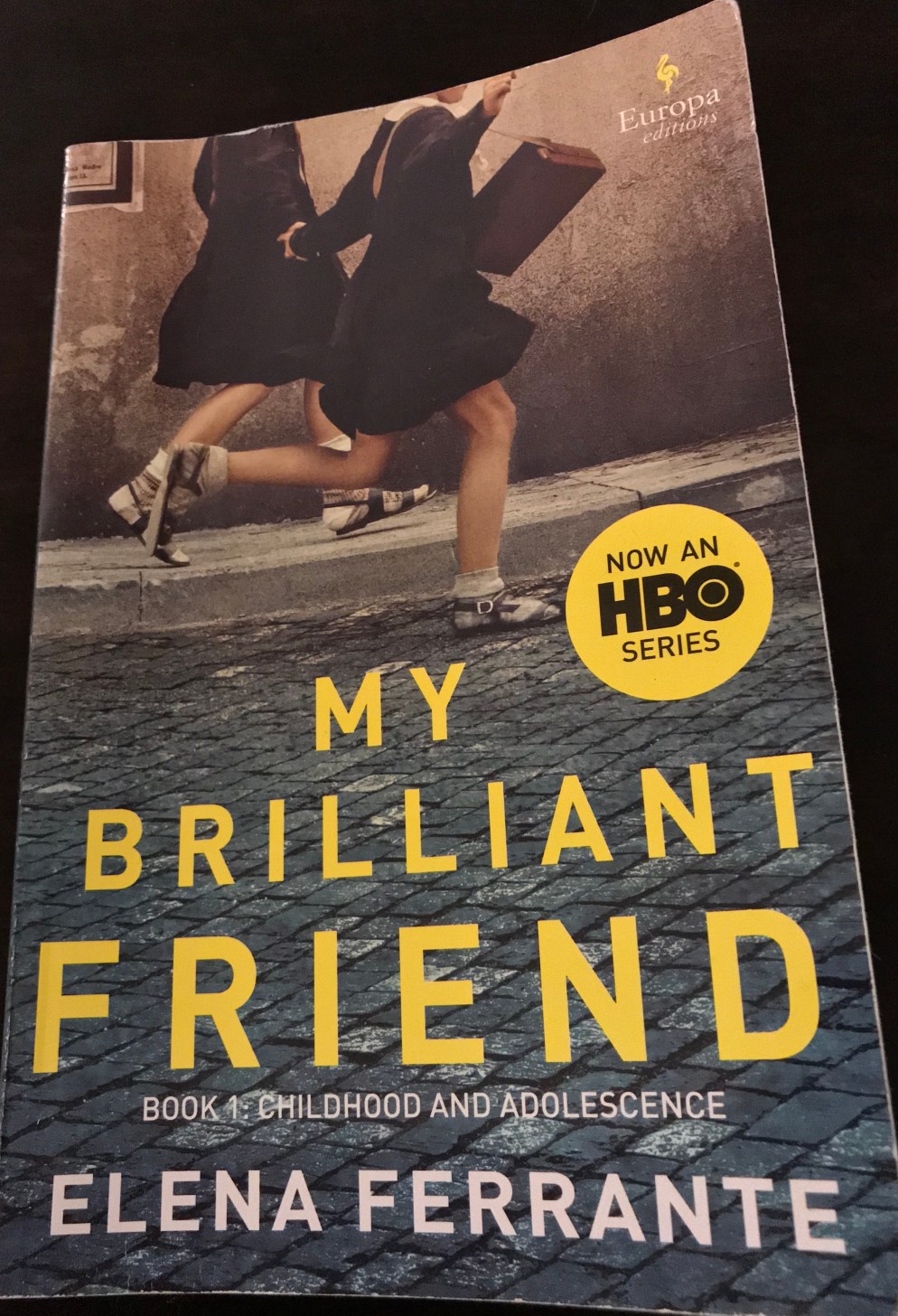
Over the last couple of months, I have voraciously read and finished Elena Ferrante’s ‘My Brilliant Friend’ novel, a series of four books which form one single story. This quartet, altogether about 1600 pages, is perhaps the longest novel I have ever read. The proof of this particular pudding lies in finishing all four of them, quite rapidly, enjoyably. Needless to say, I loved it. In some ways, this book made me break some of my well-worn habits in choosing novels to read. I rarely read anything over three to four hundred pages. I happen to think good writers should be able to pull off what they intend, the narration and the literary art, more or less within that limit. Also, I have not read many female authors. I have read a couple of books by Jhumpa Lahiri and Simone de Beauvoir that I liked. But predominantly, it’s been male novelists. I suppose it’s the curse of every habit to be broken at one point or the other. On the other hand, this novel felt like a blessing for the soul.
What got me started in the first place was that it seems there is no certainty who Elena Ferrante really is. It’s a pseudonym, merely a pen name. In the literary world, there seems to be a consensus of sorts that she is very likely this Italian woman by the name of Anita Raja. Anita Raja is a retired librarian and a freelance literary translator, who has not published any novels under her own name. Domenico Starnone, Raja’s husband, is also an Italian author of some repute. I serendipitously came across an article in The Atlantic magazine last year which posited, based on an analysis of the linkages among various works by the couple and Ferrante’s novels, that it was possibly the couple, Starnone and Raja, who wrote the novels together under the name of Elena Ferrante. This article had me intrigued. Before that, I had seen Ferrante’s books displayed in bookstores occasionally but had not taken the plunge, only skimmed the excerpts once or twice. Therefore, the article felt like seeing a voice message on one’s phone from an unknown number, and then hearing a message that is eerily resonant with some urge inside of you that you did not even know you had until that moment. As I was looking for something to read over the holidays anyway, I decided to give Ferrante’s books a try and bought the first book of the series, also named My Brilliant Friend. From then on, one quickly led me onto the other. And here I am now writing a book review of sorts, undertaking an indulgence of trying to share my thoughts as to what exactly made this novel so enjoyable.
The story covers a span of about sixty years in the lives of two Italian women, Lila and Lenu, friends since childhood. The book starts with Lenu, the narrator, receiving news from Lila’s son that she has been missing for two weeks, completely disappeared from the neighborhood without leaving any trace at all. The news does not shock Lenu very much. It’s as if she had been expecting it to happen sooner or later, after all the upheavals their lives and friendship had been through. Lila had often mentioned to Lenu that she would like to disappear, to erase all her trace entirely. And not in a suicidal sense. So, Lenu takes this news in a matter-of-fact way; she wastes no time or energy in trying to find out about Lila. Instead, it provokes her to start writing, to narrate their story right from the beginning.
They grow up poor in post-war Naples in southern Italy. Lila’s father repairs shoes for a living; Lenu’s is a porter. Most of their friends are also similarly working class, poor; children of grocers, carpenters. A few who come with wealth, the money smells funny from the exploitation with which it is tainted. Lila’s and Lenu’s parents have to stretch their resources constantly to afford their school fees and books. So the specter of having to stop their education abruptly is ever present. Amidst the squalor of poverty, violence and machismo, the girls grow up with a strong desire to gain formal education, attain wealth, sophistication. They also compete to excel and be the best student at school, win their teacher’s affections. Lila is more eccentric, mercurial, impudent. She impresses and frightens in equal measure with her intelligence, with her daring and outspoken nature. Lenu is more of an obedient type, intelligent also but a bit unoriginal, disciplined, reliable but bookish. Lila can often be insensitive, cruel, yet also pull through for friends when they really need. Such as that time when she pays for Lenu’s books so that she can continue studying although Lila herself has had to stop after primary school. They meet everyday in the neighborhood courtyard to play with their dolls and pass time aimlessly. One day, while doing so, out of spite or boredom, we don’t know, Lila throws both their dolls down into the cellar of a building where Don Achille, a neighborhood bully, a figure of hatred for the adults and terror for the children, resides. At Lila’s initiating, they undertake the daring adventure to climb up the stairs to Don Achille’s apartment. The scary images about Don Achille imprinted in their minds from the stories they have heard creates a feeling of visceral terror during this climb. They do not recover their dolls but this forlorn mission serves as a memorable bonding experience, and lays down the roots for their lifelong friendship. On another occasion, towards the end of primary school, Lila entices Lenu to skip school to go exploring beyond the familiar confines of their neighborhood. They set out on a long walk beyond the neighborhood for a first sighting of the sea in their lives. They don’t make it to the sea, and instead get caught in a heavy rainstorm on the way back. They get lashed by the rain as they hurry their way back to the neighborhood; Lenu, in addition, gets lashed by her parents too for lying and skipping school. But, despite this uncharacteristic impudence, they do not pull Lenu out of school. It is not clear whether that’s what Lila had secretly hoped would result from enticing Lenu away for the escapade; or it was just a childhood plan gone awry, in neither making it to the sea nor back home in time to avoid getting caught in the rain and the beating. Her intention is not clear to Lenu. Maybe not to Lila either.
Their friendship grows and evolves through the ensuing decades of adolescence, youth and adulthood. Each epoch brings profound changes and shocks – boyfriends, husbands, affairs, children, jobs. By the end of the first book, Lenu is married young, at sixteen, to a rich neighborhood boy, ironically, son of Don Achille. In books two and three, Lenu goes on to become a writer of moderate success and fame. Lila, on the other hand, does not continue school beyond primary school and never ever leaves the neighborhood. However, she casts a long and omnipresent shadow over Lenu’s life even when they are not both living in the same postal zone. As their lives progress, they get intertwined in complicating knots of family, friends and love. Occasionally, Lenu gets so angry and fed up with Lila that she wishes Lila would just die and go away from her life. Yet, she is not able to completely extricate herself from her ties with Lila. Every time Lila calls, she invariably answers or calls back. Lenu amasses much more knowledge than Lila about books and about the world. Yet, Lila is instrumental to Lenu’s creative output and success. For each book that Lenu publishes, the idea for the book germinates from something that Lila has mentioned to her either in passing or from some shared experience during their childhood. For instance, the theme of Lenu’s second book that she publishes is an exploration of the idea that all female characters in stories written by men represent a man’s interpretation of what the female experience is like. Like Flaubert’s Madame Bovary and Tolstoy’s Karenina. This is an idea that comes originally from Lila, in a coarse and non-scholarly fashion. Lenu puts a scholarly coat around the idea and presents it to the wider world, but the body is Lila’s. Because of this symbiosis between Lenu and Lila, sometimes it feels, and Lenu herself does so as well, that Lenu is merely just a vessel that is channeling Lila’s ideas from the backwaters of their neighborhood in southern Italy out to wider Italy, out to the broader world and to us. She often wonders and as do we, who’s really writing those books and and whose ideas are they anyway?
This obscurity between Lila and Lenu’s ideas feels pertinently analogous to not knowing who the real life person behind Ferrante is. The question of identity is a fascinating one. I believe that personal identities are fluid, and consist of multitudes. In fiction then, this fluidity and multitude is heightened because writing a novel is a complex alchemy that mixes characters and experiences, both real and imagined, as well as personal and collective, from the author’s life. This collective intelligence and experience behind a novel sometimes gets under accentuated due to natural focus on the author’s personal biography when we know who that author is. Maybe Elena Ferrante, the pseudonym, stands as a literary symbol for this multifaceted aspect of identity, particularly of a narrator who is weaving and telling us a fictional story. In choosing to not reveal her personal identity, maybe she just wants her work to be read and considered independently of whoever she is. She does not want her personal identity to be used neither as a crutch nor as an amplifier in understanding her work. She does not want her persona intermingled with her art. In an age, where we are becoming more and more obsessed with personalizing every living minute of our lives, experiences that are mundane as well as exotic, and broadcasting it out to the wider world, maybe Ferrante’s anonymity is the ultimate act of defiance against this hyper personalization. The erasure of the ‘I’ behind her stories feels like an enlightened act of self-effacement, of egolessness.
Well, whatever the reasons maybe, I loved these books immensely and maybe all the more for not knowing who the real author is. Ultimately, what resonated deeply is that broadly speaking, the novel is an extremely rich portrayal of deep layers of human relationships; relationships with those nearest and dearest to us that define and test us, and also have the power to break us occasionally. The extended cast of characters besides Lenu and Lila, the details of their stories, mesh well with the main threads of the book, and feel essential to the whole; they do not feel like annexes or footnotes. The writing is not ornamented with superfluous metaphors and analogies. It is a fairly linear, chronological narration in simple prose, and yet it elevates the experience for the reader with unvarnished words, and rich psychological detail. It feels as if Ferrante is saying: Let me not use any tired old literary technique to embellish the story into what it wasn’t; instead, let me tell you exactly what happened in their lives and the people they knew, their thoughts, actions and emotions. It is a true narration, yet in the end, as a whole these novels feel as good as any abstraction. At the very end of the book, after many years of estrangement, Lenu finds some trace of Lila again and it feels very underwhelming compared to the story she has written for one of her books. She reflects, “Unlike stories, real life, when it has passed, inclines towards obscurity, not clarity”. Indeed, real life is often messy, muddled, chaotic. Maybe the power of fiction is that only it can provide the necessary luxury and clarity, of time and space, to explore and understand the deeper interpersonal forces that shape our lives and bind us to our beloved.
 Master and the Middle